
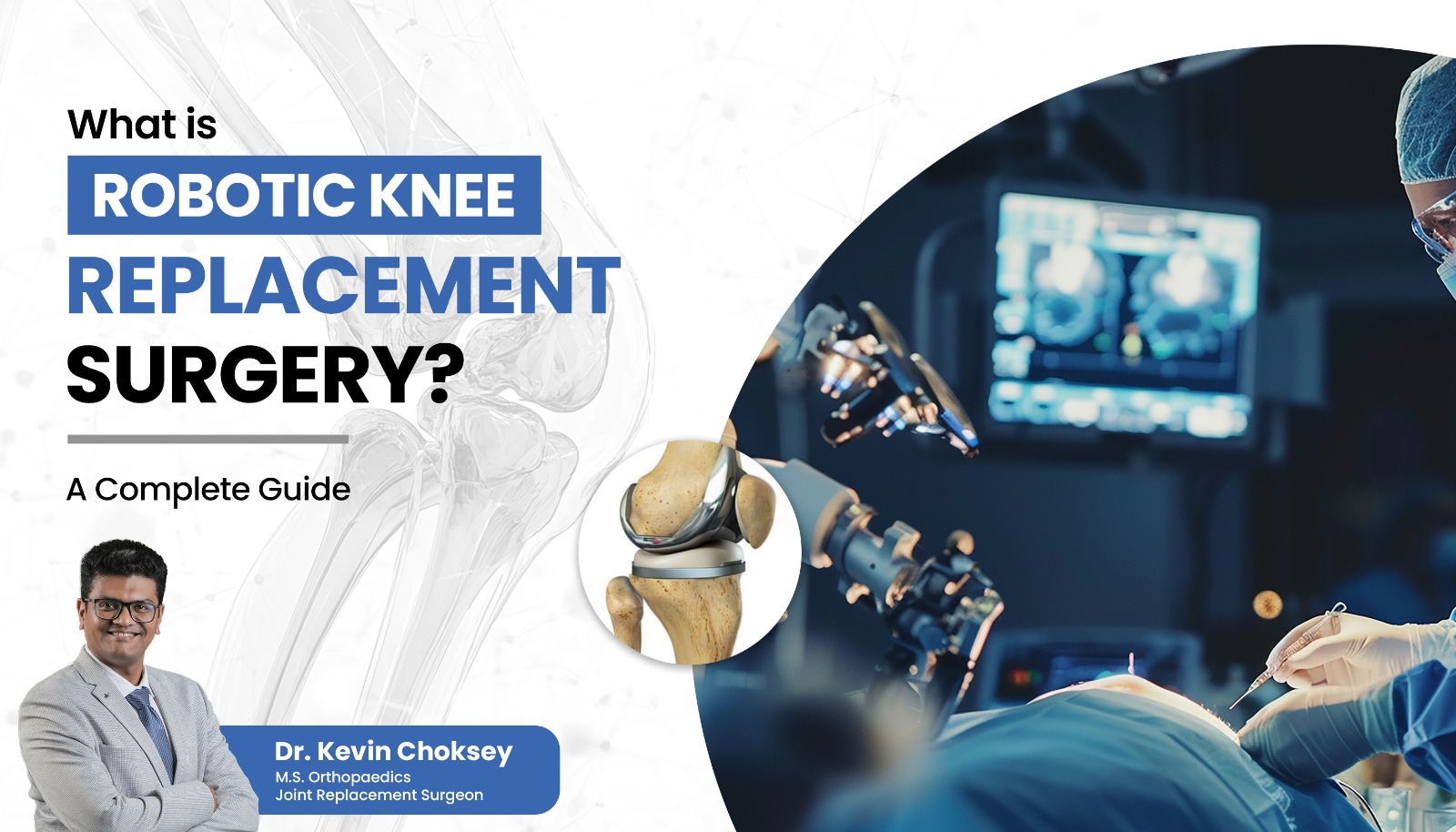
If chronic knee pain has started to limit your walking, climbing stairs, or simply getting up from a chair, you’ve probably come across the term Robotic Knee Replacement while researching treatment options. It’s one of the most talked-about advances in orthopaedics today, but for someone facing knee surgery for the first time, it can also feel confusing. What exactly makes it “robotic”? Is it safer? Does it hurt less? And how do you find the right surgeon?
This guide breaks it all down in simple terms, so you can walk into your first consultation with confidence and the right questions to ask.
What Is Robotic Knee Replacement?
Robotic knee replacement is an advanced form of Knee Replacement Surgery where the surgeon uses a robotic-arm system alongside detailed 3D imaging of your knee to plan and execute the procedure with a very high degree of accuracy. Unlike what the name might suggest, the robot does not operate on its own — the surgeon remains fully in control at every step. The robotic arm simply acts as a precision guide, helping the surgeon remove damaged bone and position the implant exactly as planned, within fractions of a millimetre. The right word is therefore, Robotic Assisted Knee Replacement Surgery.
In traditional knee replacement, surgeons rely largely on manual instruments and their own experience to judge alignment and tissue balancing. Robotic knee replacement surgery adds a layer of computer-assisted accuracy on top of that experience, which is why it has become an increasingly preferred option for patients who want the best possible fit and function from their new knee.
How Does Robotic Knee Replacement Surgery Work?
Understanding the process can help ease a lot of the anxiety that comes with surgery. Dr Kevin Choksey uses Mako SmartRobotics which is the best robotic technology for Knee Replacement at present. Here’s a simple step-by-step overview:
- 3D Mapping of Your Knee – Before surgery, a CT scan is used to build a detailed, personalised 3D model of your lower limb and the knee joint. About 40-50 parameters are assessed which give a detailed overview of the patient’s own personal anatomy.
- Surgical Planning – Your surgeon uses this model to plan the exact size, angle, and position of the implant based on your unique anatomy and alignment.
- Robotic-Guided Execution – During surgery, the robotic arm guides the surgeon’s bone cuts within the pre-planned boundaries, minimising the chance of over- or under-correction.
- Real-Time Adjustments – The system continuously checks ligament balance and joint alignment, allowing the surgeon to fine-tune the plan even during the operation.
- Implant Placement and Closure – Once the fit is verified, the implant is placed, and the incision is closed.
This level of planning is simply not possible with manual instruments alone, which is why robotic-assisted surgery tends to produce more consistent, patient-specific results.
Benefits of Robotic Knee Replacement
Patients and surgeons alike are drawn to this technique for several practical reasons:
- Personalised surgical planning based on your own knee anatomy, not a generic template. This step of planning before execution has completely changed the way knee replacements are being performed.
- More accurate implant alignment, which supports better long-term function and implant longevity.This leads to fewer alignment-related complications, reducing the likelihood of revision surgery later on.
- Much lesser tissue disruption, lesser blood loss and potentially faster early recovery, are mainly possible due to a feature of robotic technology, called Haptics. This feature allows the surgeon to perform bone cuts without disturbing any surrounding tissues and ligaments at all. Less soft tissue trauma often means less post-operative pain and stiffness.
It’s worth noting that outcomes still depend heavily on the surgeon’s skill and experience — the robotic system is a tool that enhances precision, not a replacement for surgical expertise.
Is Robotic Knee Replacement Painful?
This is one of the most common concerns patients have. During the operation itself, anaesthesia ensures you feel nothing. After surgery, some discomfort is normal, but because robotic techniques are generally less invasive to surrounding tissue, many patients report that pain is more manageable and eases faster than expected. Our care team will typically use a combination of medication, advanced nerve blocks by anaesthetists, ice therapy and guided physiotherapy to keep you comfortable in the days following surgery.
Finding the Right Robotic Knee Replacement Doctor Near You
Searching for best robotic knee replacement doctors near me or top robotic knee replacement surgeons near me can bring up a long list of options, which is why it helps to know what to actually look for:
- Specialised training and experience in robotic-assisted joint replacement, not just conventional surgery.
- Case volume — surgeons who perform robotic knee replacements regularly tend to have more refined outcomes.
- Access to updated robotic systems at the hospital they operate from
- Transparent communication about your specific case, expected outcomes, and recovery timeline.
- Patient reviews and testimonials that speak to both surgical results and post-operative care.
Why Choose Dr. Kevin Choksey for Robotic Knee Replacement?
Dr. Kevin Choksey is a top notch leading orthopaedic surgeon in Surat, with over 12 years of experience and more than 3000 successful joint replacement surgeries to his name. He specialises in Partial Knee Replacement (Microplasty), Robotic Knee Replacement, and Robotic Hip Replacement procedures combining surgical precision with a strong focus on personalised patient care.
What sets his approach apart:
A good surgeon doesn’t just perform the surgery well. He uses all his efforts to minimize pain of the patient, and enable the patient a faster recovery. He will guide you through preparation, the procedure itself, and the months of recovery that follow. Dr Kevin Choksey has developed 4 unique practices which enable the patient a faster recovery, which he collectively calls Fast Track Knee Replacement. The elements of a fast track knee replacement are:-
1. Subvastus Approach — In conventional methods, during the surgery, the main muscle of the thigh- the quadriceps muscle is cut for approaching the joint. This leads to delayed muscle recovery as well as enhanced postoperative pain and stiffness. Instead, while using the Subvastus approach to enter the knee joint, this quadriceps muscle is not cut; it is retracted to one side and repositioned in its original place as soon as the surgery is over. As a result, the muscle recovers faster and allows patient early mobilisation. Most patients are able to walk without support the very next day.
2. Robotic Technology — Gives precise alignment, lesser soft tissue damage, perfect implant positioning.
3. Cruciate Ligament Retention — The strongest ligament of the knee, ie. PCL (Posterior Cruciate ligament) can be usually preserved. Since it is a natural structure, it provides excellent stability to the knee, 30-40% lesser bone resection from the thigh bone/femur, and faster stair climbing abilities.
4. Advanced pain management strategies — Pain management starts even before the surgery. Advanced nerve blocks, light painkillers, and structured rehabilitation support help the patient regain their mobility safely, comfortably and confidently.
If persistent knee pain has been affecting your daily life, a consultation is the best first step toward understanding whether partial/total knee replacement is right for you, to help you get back on track faster and stronger.
Conclusion
Robotic knee replacement surgery has changed what patients can expect from joint replacement — more precision, more personalisation, and often a smoother recovery. But technology is only as good as the hands guiding it. Choosing an experienced, well-reviewed surgeon and following through with proper preparation and rehabilitation are just as important as the robotic system itself.
If you’re exploring your options for robotic knee replacement, reach out to Dr. Kevin Choksey’s clinic to schedule a consultation and get a clear picture of your treatment path forward.
[…] People you also robotic knee replacement information: What Is Robotic Knee Replacement Surgery? A Complete Guide […]