
Introduction
Knee pain can affect almost every part of daily life. Walking to the shops, climbing stairs, getting out of a chair, or enjoying a family outing may become increasingly difficult when knee arthritis progresses. If medicines, physiotherapy, and other non-surgical treatments no longer provide enough relief, your orthopedic surgeon may recommend knee replacement surgery.
Today, robotic-assisted knee replacement offers another option for people who need joint replacement. This technology helps surgeons plan the procedure and guide specific surgical steps using detailed information about the patient’s knee. For many patients, it raises an important question: Is robotic knee replacement right for me?
The answer depends on more than age or the severity of your pain. Your surgeon will consider your joint damage, overall health, mobility goals, treatment history, and expectations before recommending surgery. Robotic technology may support surgical precision, but it is not automatically the best choice for every patient.
Understanding these factors can help you prepare for your consultation and make a confident, informed decision.
In this guide, we explain the seven key factors your surgeon considers when evaluating you for robotic knee replacement, along with its potential benefits, risks, recovery expectations, and the importance of choosing an experienced orthopedic specialist.
What Is Robotic Knee Replacement Surgery?
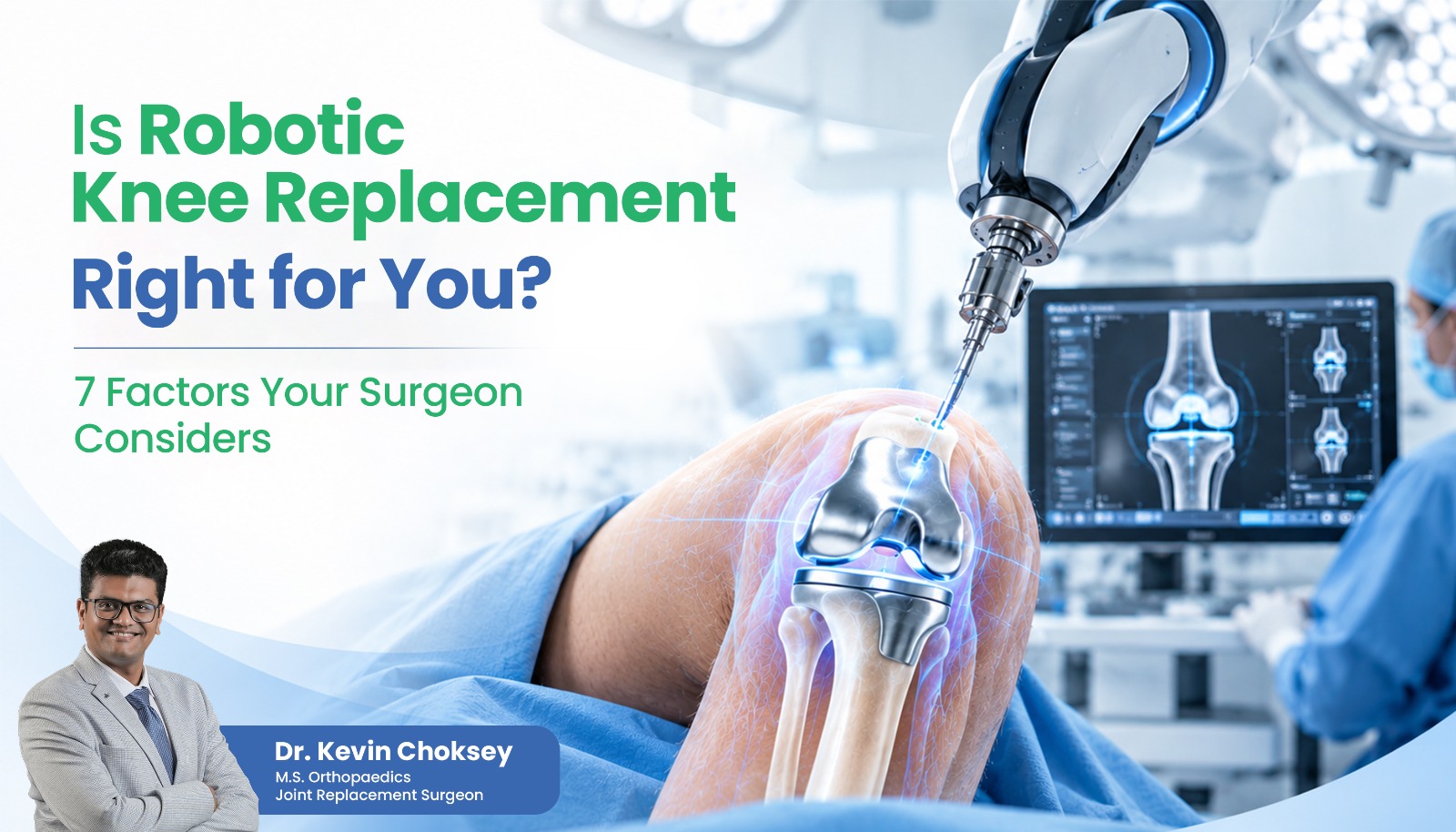
Robotic knee replacement is an advanced form of joint replacement surgery in which an orthopedic surgeon uses a robotic-assisted system to support surgical planning and guide selected parts of the procedure.
Depending on the system, the technology may use preoperative imaging, anatomical measurements, and information collected during surgery to help the surgeon assess knee alignment, plan implant positioning, and perform specific bone cuts.
The robot does not independently perform the operation. The surgeon remains responsible for assessing your condition, making clinical decisions, and carrying out the procedure.
Robotic-assisted knee replacement can be performed as a total knee replacement or, in suitable cases, a partial knee replacement.
- Total knee replacement: Damaged joint surfaces across the knee are replaced.
- Partial knee replacement: Only the affected compartment is replaced when the remaining joint structures are suitable.
The appropriate procedure depends on the pattern of arthritis, the condition of the surrounding structures, and your individual treatment needs.
7 Factors Your Surgeon Considers Before Robotic Knee Replacement
1. Severity of Knee Arthritis and Joint Damage
One of the first things your surgeon evaluates is how much damage has occurred inside your knee.
Osteoarthritis develops when the protective cartilage covering the joint surfaces gradually wears away. As the condition progresses, the joint may become painful, stiff, swollen, and difficult to move.
Your surgeon may assess your knee using a physical examination and X-rays. Additional imaging may be recommended when clinically necessary or required by the robotic system being used.
Signs that may support considering knee replacement include:
- Persistent knee pain that interferes with daily activities.
- Difficulty walking, standing, or climbing stairs.
- Stiffness that limits normal knee movement.
- Changes in knee alignment, such as bowing of the legs.
- Limited improvement despite appropriate non-surgical treatments.
If arthritis is advanced and significantly affects your quality of life, knee replacement may be worth discussing.
However, the need for knee replacement is determined by your symptoms, examination findings, imaging, and treatment goals—not by an X-ray alone. Robotic assistance is a way of performing surgery, not a reason to undergo surgery when it is otherwise unnecessary.
2. Your Age, Activity Level, and Personal Goals
Age is another factor, but there is no single age at which robotic knee replacement becomes appropriate or inappropriate.
Adults in their 50s, 60s, 70s, and beyond may be candidates if their knee condition and general health support surgery.
For younger patients, discussions may include expected implant lifespan, future activity levels, and the possibility of additional surgery later in life. Older adults may need more detailed planning around balance, muscle strength, other medical conditions, and support during recovery.
Your surgeon will also want to understand what you hope to achieve.
For example, are you hoping to:
- Walk comfortably for longer distances?
- Climb stairs with less pain?
- Return to gardening or light exercise?
- Travel more comfortably?
- Become more independent with daily activities?
These goals help your surgeon explain what knee replacement may realistically achieve.
Robotic-assisted surgery does not guarantee that you will return to every activity you enjoyed before developing arthritis. Your recovery plan should match your health, the procedure performed, and your individual goals.
3. Your Overall Health and Medical History
Knee replacement is a major operation, so your overall health matters as much as the condition of your knee.
Your surgeon and anesthesia team will review your medical history to identify issues that may affect surgical safety or healing.
Important considerations may include:
- Diabetes: Blood sugar control is important for wound healing and reducing infection risk.
- Heart or lung conditions: These may require further assessment before anesthesia.
- High blood pressure: Appropriate control can help reduce perioperative risks.
- Body weight: Excess body weight can increase stress on the knee and may affect surgical risk, although weight alone does not automatically rule out surgery.
- Previous blood clots: Your team may need to plan blood clot prevention carefully.
- Smoking: Smoking can affect healing and increase the risk of complications.
- Current medications: Blood thinners and some other medicines may require specific instructions before surgery.
Your medical team may recommend blood tests, an electrocardiogram, or other investigations based on your individual needs.
Having a chronic health condition does not necessarily mean you cannot undergo robotic knee replacement. In many cases, careful preparation and appropriate medical management can help make surgery safer.
4. Your Knee Alignment, Anatomy, and Stability
Every knee is different. The shape of your bones, the alignment of your leg, the condition of your ligaments, and the balance of the surrounding soft tissues can influence surgical planning.
Your surgeon will assess how your knee moves when you bend and straighten it, whether it feels stable, and whether there are any deformities that need to be considered.
Depending on the robotic platform, the technology may provide measurements that help the surgeon plan implant positioning and assess the knee’s movement and soft-tissue balance.
Potential advantages include:
- Detailed assessment of individual knee anatomy.
- Assistance with planning implant alignment.
- Guidance during selected surgical steps.
- Real-time information from compatible systems to support surgical decisions.
However, robotic systems differ in their capabilities. Some use preoperative CT scans, while others can work without a preoperative CT scan. Your surgeon can explain which system is available and what it offers for your case.
It is also important to remember that robotic assistance does not guarantee perfect alignment, eliminate all surgical errors, or ensure a pain-free knee.
The aim is to support careful surgical planning while allowing the surgeon to use clinical judgment throughout the procedure.
5. Whether Non-Surgical Treatments Have Been Tried
Robotic knee replacement is not usually the first treatment considered for knee osteoarthritis.
If your symptoms are manageable, your surgeon may recommend continuing with non-surgical care before considering an operation.
Depending on your condition, these options may include:
- Physiotherapy to improve strength, flexibility, and mobility.
- Appropriate pain-relief medicines.
- Weight management when relevant to your health.
- Activity modification to reduce excessive strain on the knee.
- Walking aids or other support when needed.
- Selected injections after discussing their possible benefits and limitations.
These treatments may reduce pain and improve function, although they cannot restore cartilage that has been extensively lost.
If pain continues to limit your everyday activities despite appropriate treatment, knee replacement may become a reasonable option.
During your consultation, ask whether further non-surgical treatment is likely to help or whether the expected benefits of surgery justify its risks.
The decision should be based on your needs and preferences rather than the availability of robotic technology alone.
6. Your Ability to Participate in Rehabilitation
Surgery is only one part of knee replacement treatment. Rehabilitation is essential for regaining strength, improving mobility, and returning to daily activities.
Your surgeon will consider your current mobility, muscle strength, balance, and ability to follow a postoperative exercise programme.
After surgery, physiotherapy may help you:
- Begin walking safely with suitable support.
- Improve knee bending and straightening.
- Strengthen the muscles around the joint.
- Improve balance and walking technique.
- Gradually return to everyday activities.
Some patients may begin standing or walking with assistance on the day of surgery or the following day, depending on their medical condition and the hospital’s protocol.
Recovery varies considerably. Some people progress quickly, while others need additional time because of swelling, weakness, other health conditions, or pre-existing stiffness.
Before surgery, consider whether you will have access to physiotherapy, transport to follow-up appointments, and help at home during the early recovery period.
Your surgeon and rehabilitation team can help you plan for these practical needs.
7. Your Expectations, Understanding of Risks, and Treatment Preferences
The final factor is whether the expected benefits of surgery align with your goals and whether you understand the possible limitations.
Robotic-assisted knee replacement may improve the accuracy of implant positioning in some settings and may offer advantages in surgical planning. Some patients also experience improvements in early functional recovery.
However, current evidence does not establish that robotic-assisted surgery consistently produces superior long-term pain relief, function, or implant survival for every patient compared with conventional knee replacement.
Both approaches can provide good results when performed for appropriate indications.
Like all major operations, robotic knee replacement also carries risks, including:
- Blood clots.
- Bleeding or wound-healing problems.
- Persistent pain or stiffness.
- Nerve or blood vessel injury.
- Implant loosening or wear.
- The possibility of further surgery.
Your surgeon should explain these risks, the expected recovery process, and the limitations of the procedure.
Ask questions about the surgeon’s experience, the robotic system being used, hospital facilities, postoperative support, and the total cost of treatment.
You should feel comfortable discussing your concerns and taking the time needed to make an informed decision.
People also want to know about robotic knee replacement after 50: Robotic Knee Replacement After 50: What Patients Should Know Before Surgery?
What Are the Benefits of Robotic Knee Replacement?
For suitable patients, robotic-assisted knee replacement may offer several potential advantages.
Personalized Surgical Planning
Robotic systems can help surgeons plan aspects of the procedure based on individual knee anatomy and the condition of the joint.
Assistance With Surgical Precision
Depending on the platform, robotic technology can guide selected surgical steps and help the surgeon follow the planned bone cuts and implant positioning.
Information About Knee Balance
Some systems provide measurements that help surgeons assess joint movement and soft-tissue balance during surgery.
Potential Early Recovery Benefits
Some studies report improvements in early recovery measures, but the results vary. Long-term benefits over conventional surgery are not guaranteed.
Ultimately, the outcome depends on multiple factors, including appropriate patient selection, surgical technique, pain management, rehabilitation, and overall health.
How Long Does Recovery From Robotic Knee Replacement Take?
Recovery is gradual, and the robotic approach does not guarantee a fixed or faster timeline.
- First few days: The focus is on pain control, safe movement, wound care, and beginning rehabilitation.
- First two to six weeks: Patients gradually work on walking, knee movement, and muscle strength.
- Six weeks to three months: Many patients continue improving their daily function and walking endurance.
- Three months and beyond: Strength, flexibility, and confidence may continue to improve for several months.
These are general estimates rather than deadlines. Your recovery may be shorter or longer depending on the type of surgery, your medical condition, and your rehabilitation progress.
Follow your surgeon’s instructions about medicines, wound care, walking aids, driving, exercise, and returning to work.
Seek prompt medical advice for increasing wound redness, discharge, fever, or worsening pain. Sudden chest pain or breathlessness requires emergency medical attention.
Choosing the Right Surgeon for Robotic Knee Replacement
Selecting an orthopedic surgeon is an important part of your treatment decision. Look for a specialist who can assess your knee thoroughly, explain all reasonable treatment options, and help you understand whether robotic assistance is appropriate for your case.
Consider the following:
- Experience in knee replacement surgery and relevant robotic systems.
- Access to suitable surgical facilities and anesthesia support.
- Clear communication about potential benefits and risks.
- A personalized postoperative physiotherapy plan.
- Appropriate infection-prevention and blood clot prevention measures.
- Follow-up care to monitor your recovery.
If you are considering best robotic knee replacement with Dr. Kevin Choksey, arrange a consultation to discuss your symptoms, examination findings, treatment options, and recovery expectations. Ask about his experience with robotic-assisted procedures, the facilities available for your surgery, and the rehabilitation support provided after the operation.
The best treatment choice is the one that fits your clinical needs, not simply the one that uses the newest technology.
Conclusion: Is Robotic Knee Replacement Right for You?
Robotic knee replacement may be a suitable option if severe knee arthritis is affecting your quality of life and non-surgical treatments no longer provide enough relief. However, the decision depends on several factors, including joint damage, age and activity goals, overall health, knee anatomy, previous treatments, rehabilitation needs, and your expectations.
Robotic technology can support surgical planning and precision, but it does not eliminate complications or guarantee a better result for every patient. An individualized assessment is the most reliable way to determine whether it offers meaningful advantages in your situation.
Take time to discuss your options, understand the risks, and plan for recovery with your orthopedic team.
Book a Consultation With Dr. Kevin Choksey
If persistent knee pain is affecting your mobility, independence, or quality of life, consider consulting Dr. Kevin Choksey for knee replacement evaluation.
Discuss whether robotic-assisted knee replacement is appropriate for your condition, what benefits you may reasonably expect, and how the right surgical and rehabilitation plan can support your mobility goals.
Contact Dr. Kevin Choksey’s clinic to schedule a consultation and take an informed step towards better knee health and more comfortable movement.