
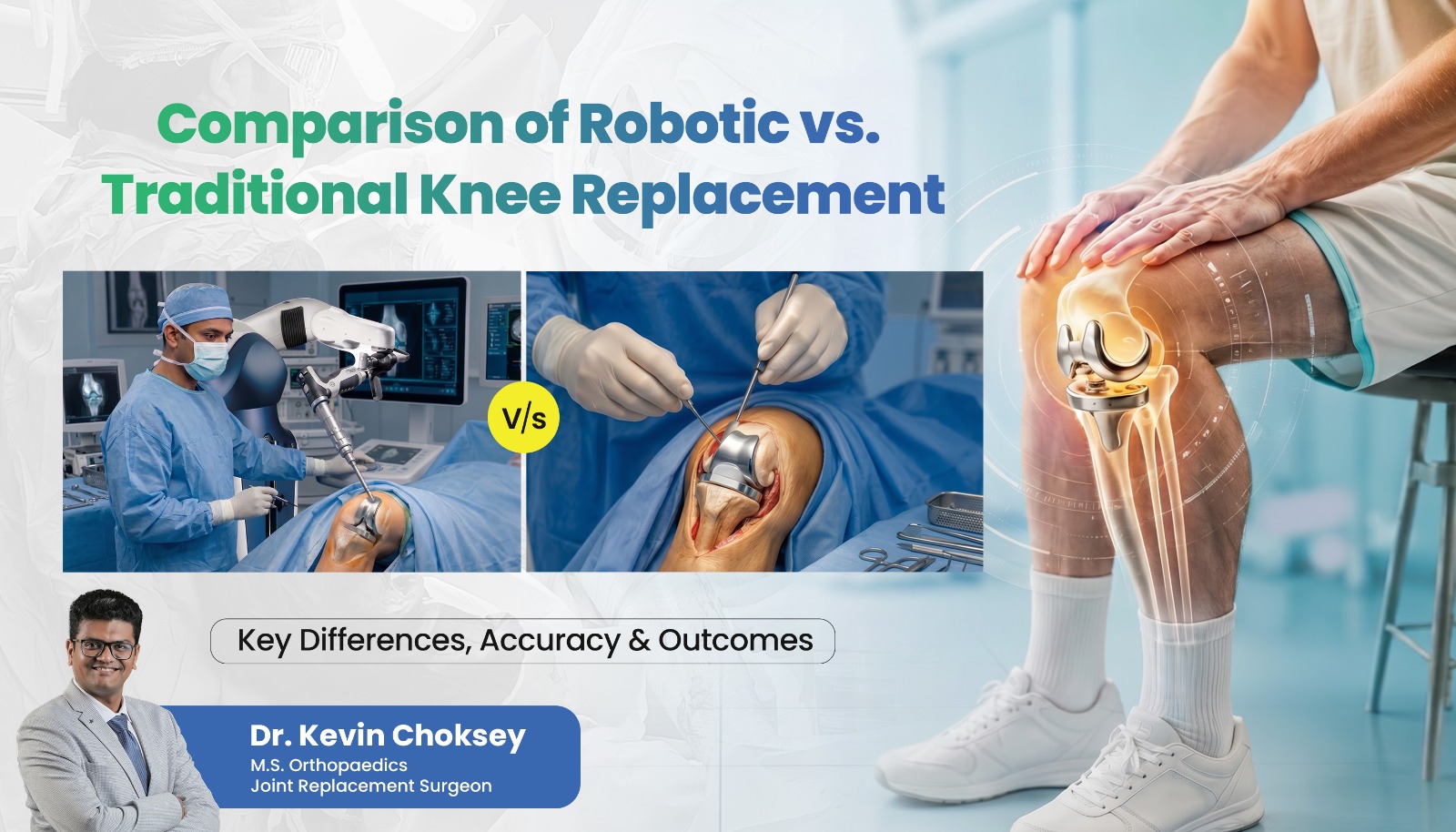
When knee pain and arthritis begin to disturb our daily routines, Knee replacement surgery becomes the next logical step. But patients today are faced with a choice that didn’t exist a generation ago: should you go with robotic knee replacement, or stick with the traditional, manual approach?
At Dr. Kevin Choksey’s clinic in Surat, this is one of the most common questions patients ask during their first consultation. ‘What exactly does this robot do and what benefit shall I have ?’ Both techniques aim to relieve pain and restore movement, but the way they get there — and the outcomes patients experience — can differ quite a bit. Here’s a clear, practical comparison to help you understand what each option involves.
What Is Robotic Knee Replacement Surgery?
Robotic knee replacement surgery doesn’t mean a robot performs the operation on its own. Instead, it’s a technology-assisted technique where the surgeon remains fully in control while a robotic arm and computer-guided imaging support every step of the procedure.
Before the surgery even begins, a CT scan of the hip, knee, and ankle is used to build a detailed 3D digital model of your unique joint. This means the surgical plan is based on your actual bone structure, wear pattern, and alignment — not a generic template. During the operation, the robotic arm uses this real-time data to guide bone preparation and implant positioning within a fraction of a millimetre, while the surgeon controls every movement.
This level of precision is what separates robotic-assisted surgery from the freehand, instinct-and-experience-driven approach of conventional surgery.
Traditional Knee Replacement: The Established Approach
Traditional (or conventional) knee replacement has been performed successfully for decades and remains a reliable, well-studied procedure. It relies on manual instruments, mechanical alignment guides, and the surgeon’s hands-on experience to remove damaged cartilage and bone and position the implant.
Advantages of the traditional approach:
- A long, well-documented track record with decades of outcome data
- Widely available, since most orthopaedic surgeons are trained in this technique
- Generally lower cost compared to robotic-assisted surgery
Where it falls short:
- Implant positioning depends heavily on the surgeon’s manual skill and visual judgment, leaving more room for variation.
- Slightly higher chances of alignment-related issues in complex or deformed knees.
- Recovery can be marginally slower due to more extensive soft tissue handling.
- The steps, once done cannot be reversed, be it extra bone cut, or even an improper soft tissue release.
Robotic vs. Traditional: Accuracy and Outcomes Compared
| Factor | Robotic Knee Replacement | Traditional Knee Replacement |
| Implant positioning | Guided by 3D imaging and real-time data, allowing sub-millimetre accuracy | Based on surgeon’s manual skill and standard instruments |
| Soft tissue balancing | More precise, personalized to each knee | Relies on intraoperative judgment |
| Bone preservation | Typically preserves more healthy bone | May require slightly more bone removal |
| Recovery time | Often faster due to a less disruptive technique | Can take a bit longer to regain full mobility |
| Complication risk | Lower risk of malalignment and implant loosening | Slightly higher risk in complex deformities |
| Cost | Higher, due to advanced technology | More budget-friendly |
| Long-term data | Better, because it is just a way of performing the standard surgery in a better way. | Extensive, decades of proven outcomes |
The bottom line: robotic assistance tends to offer greater precision and a more personalized fit, which can translate into a more natural-feeling knee and potentially fewer revision surgeries down the line.
Why Patients in India Are Choosing Robotic Knee Replacement
Robotic knee replacement in India has grown rapidly over the last few years as hospitals in metro and tier-2 cities invest in this technology. Patients are drawn to the promise of better alignment, less pain after surgery, and a quicker return to everyday activities like walking, going up and down the stairs, cross leg sitting, etc.
For those specifically searching for robotic knee replacement in Surat, the good news is that this advanced technology, once available only in large metro hospitals, is now accessible closer to home. This means patients no longer need to travel to Mumbai, Delhi, or Ahmedabad to benefit from robotic-assisted precision.
Choosing the Right Robotic Knee Replacement Surgeons Near You
Technology is only as good as the hands using it. When searching for best robotic knee replacement doctors near me or top robotic knee replacement surgeons near me, it’s worth looking beyond the equipment and asking a few important questions:
- How many robotic-assisted knee replacements has the surgeon personally performed?
- What type of robotic system does the hospital use?
- What does the fast track recovery protocol look like after surgery?
- What is the expected hospital stay and rehabilitation timeline?
With over a decade of experience and thousands of successful joint replacement surgeries, Dr. Kevin Choksey combines robotic precision with a fast track recovery approach, giving patients in Surat access to advanced, personalized knee care without having to travel out of the city.
Why Choose Dr. Kevin Choksey for Robotic Knee Replacement
Choosing the right surgeon matters just as much as choosing the right technology. Here’s what sets Dr. Kevin Choksey apart for patients considering best robotic knee replacement in Surat:
- What sets his approach apart:
A good surgeon doesn’t just perform the surgery well. He uses all his efforts to minimize pain of the patient, and enable the patient a faster recovery. He will guide you through preparation, the procedure itself, and the months of recovery that follow. Dr Kevin Choksey has developed 4 unique practices which enable the patient a faster recovery, which he collectively calls Fast Track Knee Replacement. The elements of a fast track knee replacement are
1. Subvastus Approach — In conventional methods, during the surgery, the main muscle of the thigh- the quadriceps muscle is cut for approaching the joint. This leads to delayed muscle recovery as well as enhanced postoperative pain and stiffness. Instead, while using the Subvastus approach to enter the knee joint, this quadriceps muscle is not cut; it is retracted to one side and repositioned in its original place as soon as the surgery is over. As a result, the muscle recovers faster and allows patient early mobilisation. Most patients are able to walk without support the very next day.
2. Robotic Technology — Gives precise alignment, lesser soft tissue damage, perfect implant positioning.
3. Cruciate Ligament Retention — The strongest ligament of the knee, ie. PCL (Posterior Cruciate ligament) can be usually preserved. Since it is a natural structure, it provides excellent stability to the knee, 30-40% lesser bone resection from the thigh bone/femur, and faster stair climbing abilities.
4. Advanced pain management strategies — Pain management starts even before the surgery. Advanced nerve blocks, light painkillers, and structured rehabilitation support help the patient regain their mobility safely, comfortably and confidently.
If persistent knee pain has been affecting your daily life, a consultation is the best first step toward understanding whether partial/total knee replacement is right for you, to help you get back on track faster and stronger.
This combination of experience, technology, and personalized attention is why patients searching for robotic knee replacement doctors near me or robotic knee replacement surgeons near me consistently turn to Dr. Kevin Choksey for their knee care.
Book a Consultation with Dr. Kevin Choksey
If you’re considering robotic knee replacement surgery in Surat and want a personalized recovery plan built around precision and speed, Dr. Kevin Choksey’s clinic offers best Robotic-assisted Fast Track Total Knee Replacement options tailored to your lifestyle. Reach out today to schedule a consultation and take the first step toward a pain-free, active life.