
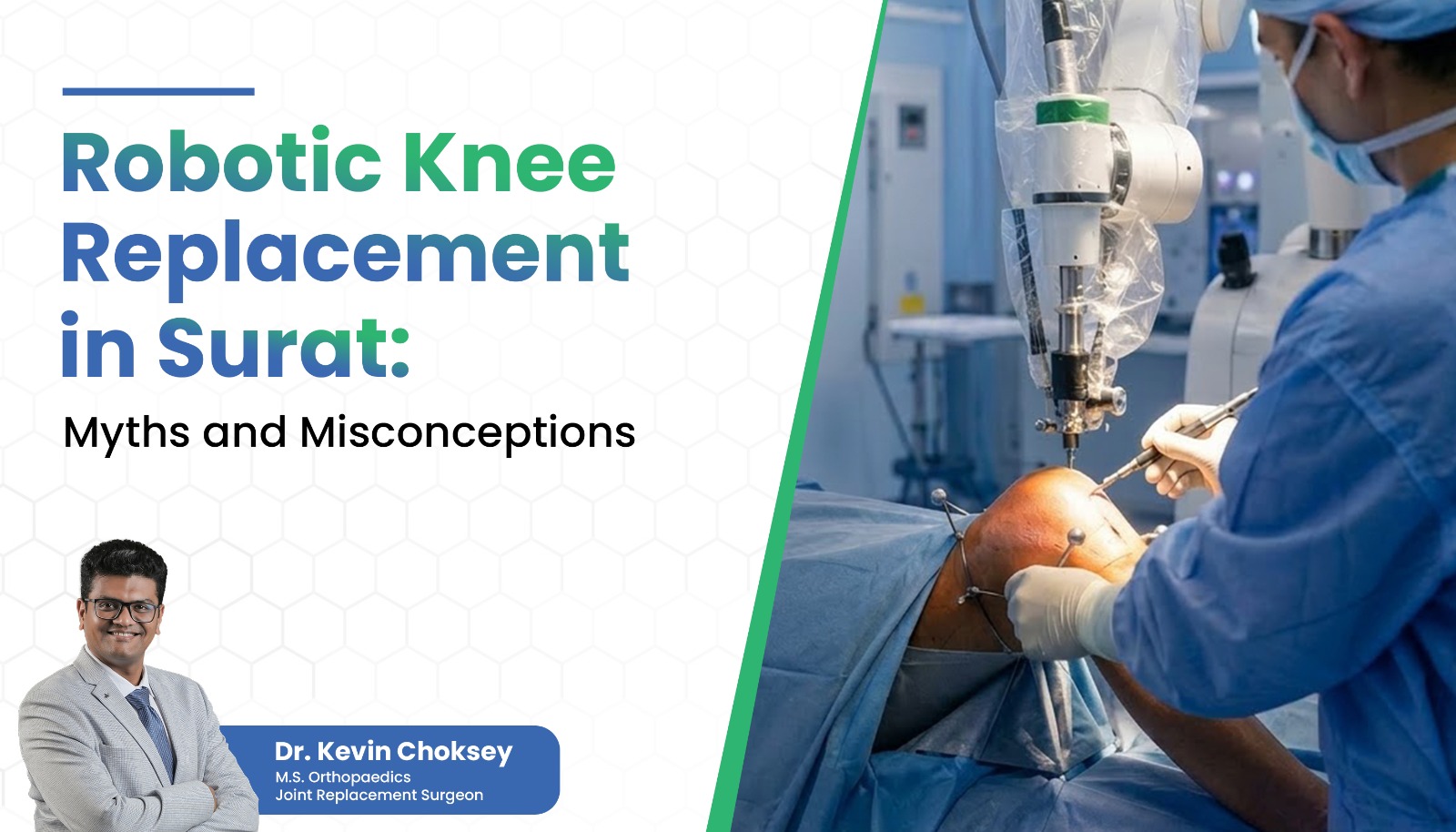
Knee pain can quietly take over a person’s life — stairs become a challenge, morning walks get shorter, and simple joys like sitting cross-legged during a family function feel unreachable. For many people in Surat dealing with advanced arthritis or joint damage, robotic knee replacement in Surat has emerged as one of the most talked-about solutions in modern orthopaedics. Yet, despite its growing popularity, the procedure is still surrounded by confusion, fear, and outdated assumptions.
If you or a loved one is considering robotic knee replacement surgery, it’s worth separating fact from fiction before deciding. In this blog, we address the most common myths about robotic knee replacement and explain what the procedure actually involves.
Myth 1: The Robot Performs the Surgery, Not the Surgeon
This is perhaps the biggest misunderstanding people have about robotic knee replacement. The name itself creates an image of a machine operating independently while the surgeon watches from the sidelines. In reality, nothing could be further from the truth.
The robotic system is a highly advanced surgical assistant — it does not think, decide, or move on its own. The surgeon plans the entire procedure, controls every movement, and makes every clinical judgment throughout the operation. The robotic arm simply helps translate that plan into the operating room with a level of precision that the human hand alone cannot always guarantee. The skill, training, and experience of the surgeon remain the single most important factor in the outcome of the surgery.
Myth 2: Robotic Surgery Is Riskier Than Traditional Knee Replacement
Many patients assume that adding technology to the operating room adds risk. In practice, robotic-assisted surgery is designed to reduce risk, not increase it.
Before the procedure, a detailed CT scan is used to build a 3D digital model of the patient’s own knee. This allows the surgeon to plan implant size, positioning, and alignment with millimetre-level accuracy, based on the patient’s real anatomy rather than an average template. This pre-planning reduces the chances of implant malalignment, soft-tissue injury, and the kind of small errors that can occur with manual instrumentation — ultimately making the procedure more predictable and safer for the patient.
Not only that, the Haptics feature of the robotic system, allows the surgeon only to cut required amount of bone, without causing any damage to the surrounding ligaments and tissues, thus enhancing the safety of the procedure.
Myth 3: Robotic Knee Replacement Is Only for the Wealthy
There’s a common belief that robotic knee replacement in India is an expensive, premium option reserved only for those with deep pockets. While robotic systems do involve advanced technology, the cost has become far more accessible over the last few years as more hospitals in cities like Surat have adopted this equipment.
When people ask about robotic knee replacement surgery cost, it’s important to compare it against the bigger picture — shorter hospital stays, faster recovery, less post-operative physiotherapy, and a lower chance of revision surgery down the line. Many patients find that the long-term value more than justifies the initial investment. Every hospital and surgeon may price the procedure differently depending on the implant used, the robotic system, and the length of hospital stay, so it’s best to have a detailed cost discussion during your consultation.
Myth 4: Recovery Takes Longer With Robotic Surgery
It’s actually the opposite. Because robotic assistance allows for smaller, more precise incisions and less disruption to the surrounding muscles and soft tissue, patients typically experience less post-operative pain and swelling. This translates into earlier mobilisation — many patients are up and walking with support within a day of surgery.
This ties in closely with Fast Track Total Knee Replacement protocols, where the focus is on getting patients moving sooner, managing pain proactively, and reducing hospital stay to just a couple of days instead of a week or more. When robotic precision is combined with a fast-track recovery approach, patients often return to daily activities noticeably faster than with conventional surgery.
Myth 5: Robotic Knee Replacement Isn’t as Effective as Traditional Surgery
Some patients worry that the “newer” option might be less proven. In reality, robotic-assisted knee replacement has been extensively studied and has shown outcomes that are equal to, or better than, conventional techniques — particularly in terms of implant alignment, joint balance, and long-term implant survival.
Better alignment means the artificial joint wears more evenly over time, which can translate into a longer-lasting implant and a more natural-feeling knee for everyday movement.
Myth 6: Robotic Technology Replaces the Need for a Skilled Surgeon
A recurring fear is that hospitals are simply relying on machines instead of experienced doctors. This isn’t how technology works. Robotic systems are tools that extend a surgeon’s capabilities — they don’t replace clinical judgment, experience, or the ability to handle unexpected situations during surgery.
This is why, when researching robotic knee replacement doctors near me, the surgeon’s training and surgical volume should matter just as much as the technology being used. The best outcomes happen when an experienced surgeon uses robotic assistance as an added layer of precision, not as a substitute for expertise.
Myth 7: There Is Only One Type of Robotic Knee Replacement
Patients are often surprised to learn that there are different types of robotic knee replacement, depending on the extent of joint damage and the patient’s specific needs:
-
Robotic Total Knee Replacement
–for patients with extensive arthritis affecting the entire knee joint.
-
Robotic Partial Knee Replacement (Microplasty)
–
for patients whose damage is limited to one compartment of the knee, allowing more of the natural joint and ligaments to be preserved. It is a high performance procedure, allowing patients to perform all natural movements and give an excellent recovery. You must ask your doctor if you are eligible for a partial knee replacement.
Choosing the right type depends entirely on an individual’s diagnosis, imaging, and overall joint health — which is why a thorough clinical evaluation is essential before deciding on a surgical approach.
Why Choose Dr. Kevin Choksey for Robotic Knee Replacement Surgery in Surat?
When you’re searching for best robotic knee replacement surgeons near me in Surat, experience, technology, and patient-centred care all matter. Dr. Kevin Choksey brings all three together.
With over 12 years of experience and more than 3000 successful joint replacement surgeries, Dr. Kevin Choksey is recognised as one of the best Surat’s leading orthopedic surgeons, specializing in robotic knee replacement, microplasty (partial knee replacement), total knee replacement, and for Hip Replacements with Direct Anterior Approach. Here’s what sets his approach apart:
- What sets his approach apart:
A good surgeon doesn’t just perform the surgery well. He uses all his efforts to minimize pain of the patient, and enable the patient a faster recovery. He will guide you through preparation, the procedure itself, and the months of recovery that follow. Dr Kevin Choksey has developed 4 unique practices which enable the patient a faster recovery, which he collectively calls Fast Track Knee Replacement. The elements of a fast track knee replacement are - 1. Subvastus Approach — In conventional methods, during the surgery, the main muscle of the thigh- the quadriceps muscle is cut for approaching the joint. This leads to delayed muscle recovery as well as enhanced postoperative pain and stiffness. Instead, while using the Subvastus approach to enter the knee joint, this quadriceps muscle is not cut; it is retracted to one side and repositioned in its original place as soon as the surgery is over. As a result, the muscle recovers faster and allows patient early mobilisation. Most patients are able to walk without support the very next day.
- 2. Robotic Technology — Gives precise alignment, lesser soft tissue damage, perfect implant positioning.
- 3. Cruciate Ligament Retention — The strongest ligament of the knee, ie. PCL (Posterior Cruciate ligament) can be usually preserved. Since it is a natural structure, it provides excellent stability to the knee, 30-40% lesser bone resection from the thigh bone/femur, and faster stair climbing abilities.
4. Advanced pain management strategies — Pain management starts even before the surgery. Advanced nerve blocks, light painkillers, and structured rehabilitation support help the patient regain their mobility safely, comfortably and confidently.
If persistent knee pain has been affecting your daily life, a consultation is the best first step toward understanding whether partial/total knee replacement is right for you, to help you get back on track faster and stronger.
- Patient-First Approach: Beyond the operating room, Dr. Choksey takes time to listen, explain the procedure clearly, and tailor treatment recommendations to each patient’s lifestyle, activity level, and long-term goals.
- Comprehensive Joint Care: From partial knee replacement for early-stage arthritis to complex revision surgeries, patients get a single point of expert care through every stage of their treatment journey.
For anyone in Surat weighing their options for joint replacement, this combination of surgical precision, modern technology, and genuine patient care is what makes a real difference to long-term outcomes.
Making an Informed Decision
Robotic knee replacement has come a long way, and most of the fears surrounding it stem from misinformation rather than fact. The technology exists to support — not replace — a skilled surgeon’s judgment, and when used correctly, it can lead to more accurate surgery, less pain, and a faster return to normal life.
If you’ve been living with persistent knee pain and are exploring robotic knee replacement surgery as an option, the best first step is a proper clinical evaluation. Understanding your specific condition, discussing the right type of procedure, and getting clarity on cost and recovery expectations will help you move forward with confidence, rather than assumptions.
Book a consultation with Dr. Kevin Choksey to discuss whether robotic knee replacement is the right option for you.