
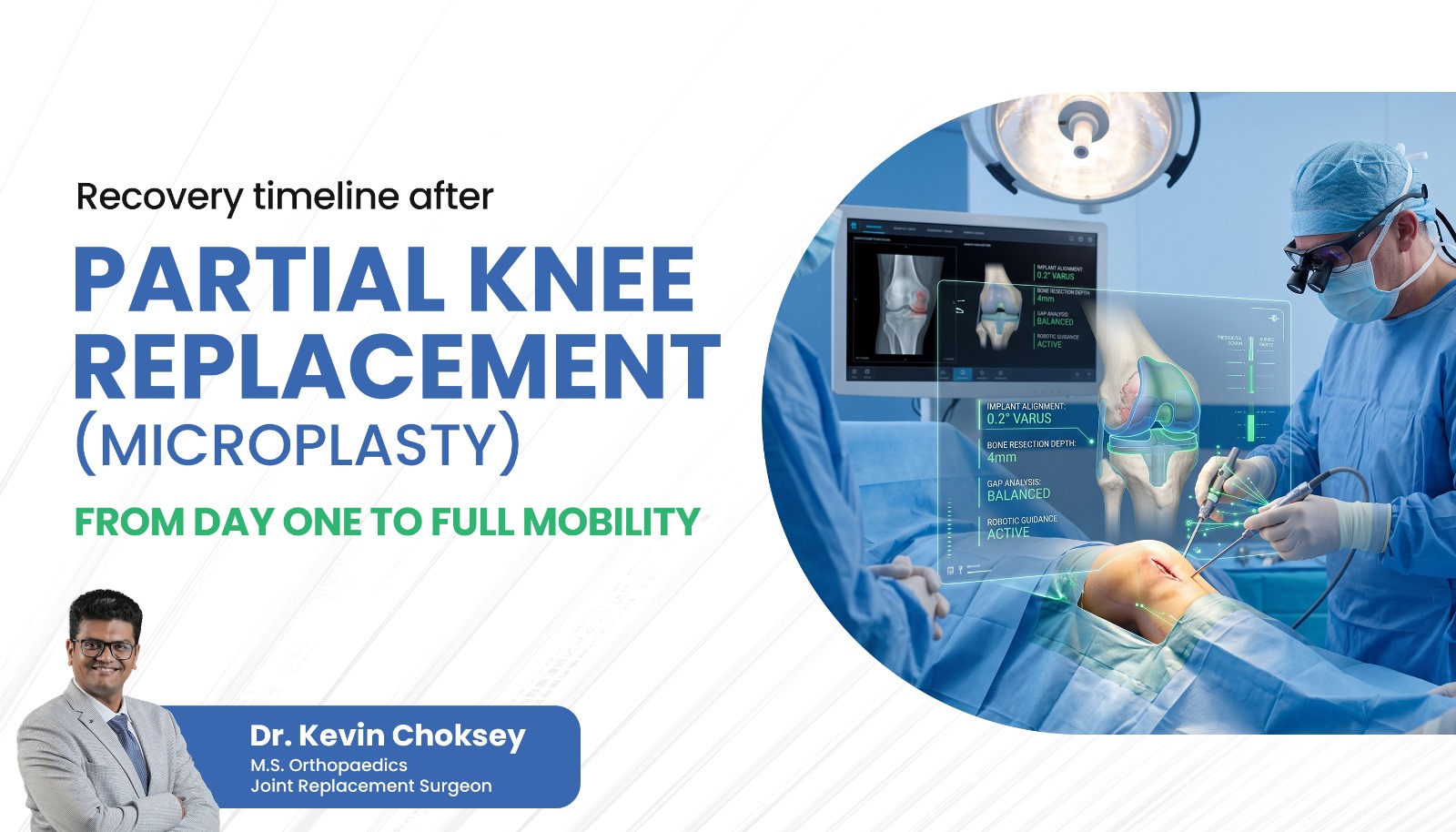
Knee pain that limits your daily life doesn’t always call for a total replacement. For many patients with damage confined to one part of the knee, Unicompartmental Knee Replacement/ Partial Knee Replacement/ Microplasty, commonly known as a half knee replacement offers a smaller, more targeted way back to pain-free movement. If you’re considering this procedure, one of the first questions you’ll have is simple: what does recovery actually look like, day by day?
This guide walks you through what to expect after microplasty knee surgery — from the first hours in the recovery room to the point where you’re back on your feet with full mobility.
What Is Microplasty?
Microplasty is a modern, minimally invasive approach to resurfacing a single damaged compartment of the knee, rather than replacing the entire joint. It’s designed for patients whose arthritis or wear is limited to one area — most often the inner (medial) side of the knee — while the rest of the joint, along with its ligaments, remains healthy.
Because only the damaged portion of the knee is treated, the surgery involves smaller incisions, less disruption to surrounding bone and tissue, and a recovery process that’s generally faster and less painful than what’s needed after treating the entire joint. Patients often describe the knee as feeling more “natural” afterward, since much of their own bone and cartilage is preserved.
If you’d like to understand how the procedure itself works, Dr. Kevin Choksey’s microplasty page outlines the surgical technique, candidacy criteria, and what makes this approach different from a more extensive procedure.
Who Is a Candidate for Microplasty?
Not everyone with knee pain is a candidate for this procedure. It tends to work best for patients who have:
- Arthritis or cartilage damage limited to one compartment of the knee
- Intact and stable ligaments (particularly the ACL)
- A reasonably active lifestyle with a healthy body weight
- Knee pain that hasn’t responded well to conservative treatments like physiotherapy, injections, or medication
An experienced orthopedic surgeon will confirm candidacy through a physical exam and imaging before recommending this option over other forms of surgical treatment.
Recovery Timeline: What to Expect
Day 0: The Surgery Day
Most patients are up and walking with support — a walker or crutches — within a few hours of surgery, often the same day. Because the procedure is less invasive, blood loss and tissue trauma are minimal, which means pain levels are typically more manageable from the outset.
Days 1–3: Hospital Discharge
A physiotherapist usually visits before discharge to begin gentle range-of-motion exercises and review a home exercise plan. Most patients usually begin to walk without any support and manage stairs before leaving the hospital.
Many patients go home within one to three days. Swelling and mild discomfort around the knee are normal at this stage. Ice, elevation, and prescribed pain management help keep this comfortable. Walking short distances is encouraged. And the patient navigates through his/her daily routine. Sitting on the table, going to the kitchen to fetch a glass of water on their own, are some activities which we encourage.
Week 1: Settling In at Home
The focus during the first week is gentle movement and swelling control. Most patients can bend the knee to around 90 degrees by the end of this week. Light home exercises — heel slides, ankle pumps, and assisted knee bends — are introduced to prevent stiffness.
Weeks 2–3: Building Strength
By the second and third week, walking distances typically increase, and many patients can move around the house without a walking aid, using a cane mainly for confidence outdoors. Physiotherapy sessions ramp up, focusing on quadriceps strengthening, balance, and improving knee flexion. Some patients return to light desk work as early as this stage, depending on their job and how they’re progressing.
Weeks 4–6: Regaining Independence- Return to normal
This is often when patients notice the biggest jump in confidence. Walking without support becomes common, stairs get easier, and everyday activities — cooking, light shopping, short outings — start to feel normal again. Physiotherapy continues to focus on strength and flexibility, aiming for a knee bend close to full range. most patients have resumed the majority of their daily routines, including driving (once cleared by the surgeon) and low-impact activities like walking longer distances or swimming. Strength continues to build steadily, and any residual stiffness or mild swelling usually continues to improve.
Weeks 6–12: Full Mobility
Full recovery after microplasty is generally faster than after more extensive knee procedures. By three to six months, most patients report near-normal or fully normal knee function, with the ability to walk, climb stairs, and engage in low-impact sports without discomfort. Some patients notice continued small improvements in strength and stamina even beyond this point.
Note: Every patient heals differently. Age, activity level, overall health, and how closely you follow your physiotherapy plan all influence how quickly you move through these stages.
Why Recovery Is Often Faster with Microplasty
Compared to procedures that address the whole knee joint, microplasty preserves more of your natural bone, cartilage, and ligaments. This has a few practical benefits for recovery:
- Less surgical trauma means less post-operative pain and swelling
- Preserved ligaments mean the knee often feels more stable and “natural” sooner
- Smaller incisions typically translate to a shorter hospital stay
- Faster return to daily activities, often within weeks rather than months
Why Choose Dr. Kevin Choksey for Microplasty or Partial Knee Replacement?
Choosing the right surgeon matters as much as choosing the right procedure. Here’s what sets Dr. Kevin Choksey apart for patients considering microplasty or partial knee replacement:
- Specialized expertise: Dr. Kevin Choksey is recognized among the best partial knee replacement surgeons in the region, with focused experience in microplasty and other minimally invasive knee procedures.
- Personalized evaluation: Every patient undergoes a thorough assessment to confirm candidacy for microplasty versus other treatment options, ensuring the recommended procedure genuinely fits their knee condition.
- Advanced surgical technique: Using precise, minimally invasive methods, Dr. Choksey focuses on preserving healthy bone and ligament tissue to support faster, more comfortable recovery.
- Comprehensive rehabilitation support: Patients receive a structured, guided recovery plan with physiotherapy support at every stage, from the first post-operative day through to full mobility.
- Trusted care in Gujarat: As one of the best knee replacement surgeons in Gujarat, Dr. Choksey is known for combining surgical precision with clear, compassionate patient communication.
- State-of-the-art facility: Operating out of one of the best knee replacement hospitals in Surat, patients benefit from modern surgical infrastructure and a dedicated post-operative care team.
- Robotic Technology: Dr Choksey is one of the very few surgeons across the country who specialise in Robotic Partial Knee Replacement surgery. This is a procedure which is the best possible blend of Biology (Nature Knee Preservation) and Technology, to ensure best results for the patients.
If you’re exploring your options for microplasty or partial knee replacement, learn more about the procedure and consultation process on Dr. Kevin Choksey’s microplasty service.
Conclusion
Recovery after microplasty is generally quicker and smoother than many patients expect, thanks to the minimally invasive nature of the procedure. While everyone’s timeline looks a little different, most patients are walking unaided within days and almost back to full mobility within a month. If knee pain has been holding you back and you’d like to know whether microplasty is right for you, scheduling a consultation is the best next step toward getting your mobility back.
This article is for general informational purposes and does not replace personalized medical advice. Please consult Dr. Kevin Choksey or a qualified orthopedic surgeon to discuss your specific condition and treatment options.
[…] People also want to know about recovery timeline after partial knee replacement: Recovery Timeline After Partial Knee Replacement (Microplasty) : From Day One to Full Mobility […]