
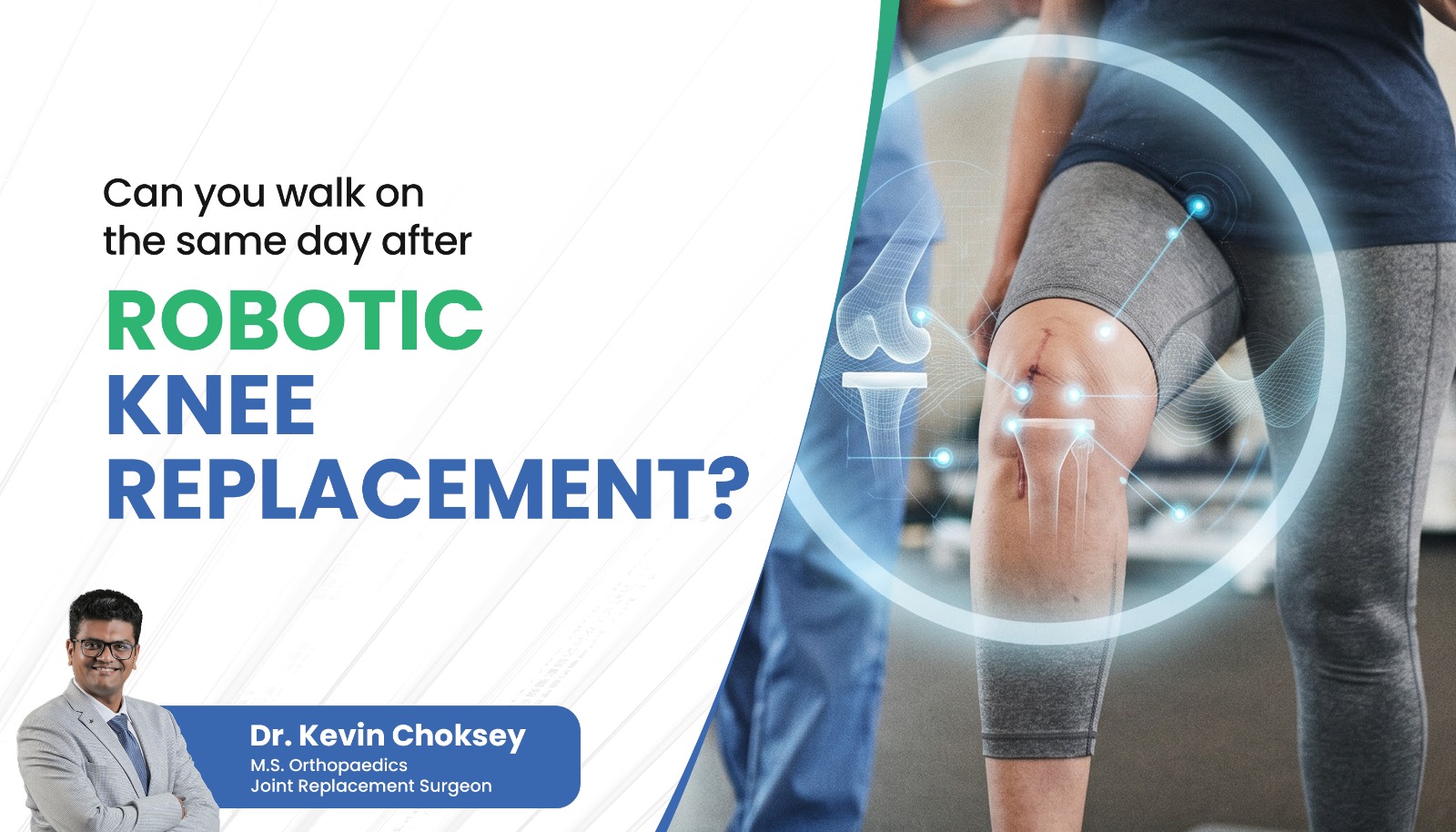
For many people considering knee replacement surgery, one question comes up again and again:
“Will I be able to walk on the same day after surgery?”
The answer is often yes — many suitable patients can stand and take their first steps on the day of robotic knee replacement surgery, usually with the support of a physiotherapist, walker, or other walking aid.
However, walking on the same day does not mean walking normally or independently immediately after surgery. Your first few steps are part of a carefully supervised recovery process.
Modern knee replacement surgery increasingly focuses on early mobilisation, pain control and faster functional recovery. Current clinical guidance recommends beginning physical therapy and mobilisation within 24 hours of total knee replacement, and rehabilitation may begin on the day of surgery when possible.
So, what can you realistically expect after robotic knee replacement?
What Is Robotic Knee Replacement?
Robotic knee replacement is an advanced approach to knee replacement surgery in which the surgeon uses robotic technology and detailed planning to help perform the procedure with precision.
Importantly, the robot does not perform the surgery independently. The orthopaedic surgeon remains in control throughout the procedure. Robotic technology can assist with planning, alignment and accurate execution of the planned bone cuts and implant positioning.
The goal is not simply to use advanced technology. The larger goal is to provide an appropriately selected patient with a well-planned knee replacement and a pathway toward restoring mobility and quality of life.
Can You Walk on the Same Day After Robotic Knee Replacement?
In many cases, yes.
If your surgery and immediate recovery are uncomplicated, your medical team may help you get out of bed and take your first steps within several hours after surgery.
Your first walk may involve:
- Sitting up and getting out of bed with assistance
- Standing with support
- Taking a few steps using a walker
- Walking a short distance under supervision
- Performing simple knee and ankle movements
- Learning how to safely sit, stand and change direction
The exact timing varies from patient to patient.
Your age, general health, muscle strength, balance, pain control, type of surgery, anaesthesia recovery and medical history can all influence when it is safe to begin walking.
Why Is Early Walking Encouraged?
Early mobilisation is not about proving how quickly you can walk.
It is about helping your body begin the recovery process safely.
Early physical therapy after total knee replacement is associated with improved early functional recovery, and current guidance supports beginning physical therapy within 24 hours after surgery.
Getting mobile early can help you:
- Begin using the new knee in everyday movements
- Reduce stiffness
- Restore confidence with movement
- Start rebuilding muscle strength
- Improve walking function
- Work toward greater independence
- Progress toward returning home safely
It is also important to understand that early walking should be progressive, not excessive.
What Does “Walking on the Same Day” Actually Mean?
This is where patients sometimes have unrealistic expectations.
Walking on the day of surgery usually means short, supervised walking, not walking around the neighbourhood, climbing several flights of stairs or walking without assistance.
For example, your first walk may simply involve moving from the bed to a chair and taking a few steps.
As your strength, balance and confidence improve, the distance can gradually increase.
Think of it as:
Day 1: Start moving →
Next few days: Build control →
Following weeks: Build strength and endurance →
Long term: Return to meaningful daily activities
Your recovery should be measured by safe progress, rather than by how much you can do immediately after surgery.
How Long Does It Take to Walk Normally After Knee Replacement?
There is no single timeline that applies to everyone.
Some patients become comfortable walking with a walker very quickly. Others need more time before they feel confident putting weight through the operated leg.
Over the following days and weeks, physiotherapy focuses on improving:
Knee movement
You gradually work on bending and straightening the knee so that everyday activities become easier.
Muscle strength
The muscles around the knee and hip may be weak after surgery. Targeted exercises help rebuild strength.
Balance
Good balance is important for safe walking, turning, getting out of a chair and using stairs.
Walking pattern
You learn to place your foot properly, improve your step pattern and gradually reduce dependence on walking aids when appropriate.
Functional independence
The ultimate goal is not simply to achieve a certain walking distance.
It is to help you return to activities that matter to you — getting around your home, going outside, managing stairs, travelling, working or spending time with family.
Does Robotic Surgery Mean Faster Recovery?
This is an important distinction.
Robotic-assisted knee replacement can provide highly detailed surgical planning and may improve the accuracy of implant positioning in some circumstances. However, robotic technology should not be presented as a guarantee of faster recovery for every patient.
The American Academy of Orthopaedic Surgeons notes that evidence has not established a significant short-term difference in function, outcomes or complications between robotic-assisted and conventional total knee replacement, although some studies show improved accuracy with robotic assistance.
Your recovery depends on much more than the technology used during surgery.
Factors such as:
- Your overall health
- Muscle strength before surgery
- Knee condition
- Weight and fitness
- Pain management
- Surgical technique
- Rehabilitation
- Commitment to prescribed exercises
- Home support
- Other medical conditions
can all influence recovery.
That is why choosing the right surgeon and a structured recovery plan is just as important as choosing the technology.
What Happens During the First 24 Hours?
After surgery, your healthcare team will monitor you while you recover from anaesthesia and ensure your pain is adequately controlled.
Depending on your individual condition, rehabilitation may include:
- Getting out of bed safely
A physiotherapist or trained healthcare professional can guide you through your first movement.
- Standing
You may first stand with support to assess your balance, strength and tolerance.
- Short-distance walking
If you are stable, you may take a few steps with a walker.
- Knee exercises
Simple exercises may be introduced to encourage movement and muscle activation.
- Safety education
You may learn how to move around safely, use your walking aid and manage everyday movements.
Current NICE guidance recommends rehabilitation on the day of surgery where possible and no later than 24 hours after elective knee replacement.
When Can You Walk Without a Walker?
This varies considerably.
Some people progress quickly, while others need a walker or cane for longer.
Do not stop using your walking aid simply because you feel that you “should” be walking independently.
A walking aid can provide stability while your muscles, balance and coordination recover.
Your surgeon and physiotherapist can assess:
- Whether you can walk safely
- Whether you are limping
- Your balance
- Your muscle control
- Your pain level
- Your knee movement
Only then should you gradually reduce your dependence on walking support.
Safe walking is more important than fast walking.
What Can Help You Recover Faster?
The best preparation for knee replacement begins before surgery.
Prepare your body
If your surgeon recommends preoperative exercises or physiotherapy, follow the programme consistently. Preoperative rehabilitation can improve strength, flexibility and endurance before surgery and may support early postoperative recovery.
Follow your rehabilitation plan
Do not compare your recovery with someone else’s.
Your physiotherapy programme should be adjusted according to your progress and tolerance.
Keep moving safely
Once your medical team allows it, regular movement is generally better than remaining inactive for prolonged periods.
Take pain medicines as prescribed
Good pain control can make it easier to participate in rehabilitation.
Take care of your wound
Follow your surgeon’s instructions regarding wound care and keep follow-up appointments.
Give your body time
The fact that you can walk on the same day does not mean your knee has completely healed.
Internal healing and rehabilitation continue for weeks and months.
When Should You Contact Your Doctor?
Recovery after knee replacement is usually gradual, but certain symptoms require medical attention.
Contact your healthcare team if you experience concerning symptoms such as:
- Increasing rather than improving pain
- Significant swelling
- Wound drainage or increasing redness
- Fever or chills
- Sudden worsening of mobility
- Severe calf pain or swelling
- Chest pain
- Unexplained shortness of breath
Your surgical team should provide specific instructions about what symptoms require urgent evaluation.
The Bigger Goal: Getting Back to Your Life
For someone considering knee replacement, the real goal is rarely simply “I want to walk on the same day.”
The bigger question is:
“When will I be able to live my life with less knee pain and more confidence?”
You may want to walk comfortably with your family, return to work, travel, climb stairs, exercise, shop independently or simply get out of a chair without thinking about your knee.
That is what successful knee replacement recovery should focus on.
Early walking is just the beginning.
A well-planned recovery combines appropriate surgery, pain management, physiotherapy, gradual activity and regular medical follow-up. Current rehabilitation guidance supports early mobilisation while emphasising progressive activity based on safety, functional tolerance and the patient’s individual response.
Frequently Asked Questions
Is walking on the same day after robotic knee replacement safe?
For appropriately selected patients with an uncomplicated recovery, early mobilisation can be safe when performed under professional supervision. Your surgeon and rehabilitation team will decide when you are ready.
Will I walk without support on the day of surgery?
Usually, the first walk involves assistance and a walking aid such as a walker. Independent walking comes later as strength and balance improve.
Does robotic knee replacement hurt less?
Robotic assistance does not guarantee less postoperative pain. Pain varies between patients and depends on several factors. The focus should be on effective pain management and progressive rehabilitation.
How soon can I return to normal activities?
Recovery varies. Some daily activities may become easier relatively quickly, while strength, endurance and confidence can continue improving over several weeks or months.
Is robotic knee replacement suitable for everyone?
Not necessarily. The decision depends on your knee condition, medical history, functional goals and the surgeon’s assessment. A personalised consultation is important before deciding on knee replacement surgery.
Conclusion
Yes, many patients can take their first steps on the same day after robotic knee replacement.
But the goal is not to rush recovery.
The goal is to begin moving safely, confidently and progressively.
Robotic technology can support precise surgical planning, but your long-term outcome also depends on the surgical plan, your overall health, rehabilitation and commitment to recovery.
If chronic knee pain is affecting your mobility, sleep, work or quality of life, it may be time to discuss whether knee replacement is right for you.
For expert guidance on robotic knee replacement, knee replacement surgery and hip replacement, consult Dr. Kevin Choksey for a personalised assessment and treatment plan.
Your goal isn’t just to replace a knee. It’s to get back to living with confidence.
Visit Dr. Kevin Choksey to learn more about knee and hip replacement options and take the next step toward better mobility and quality of life.