
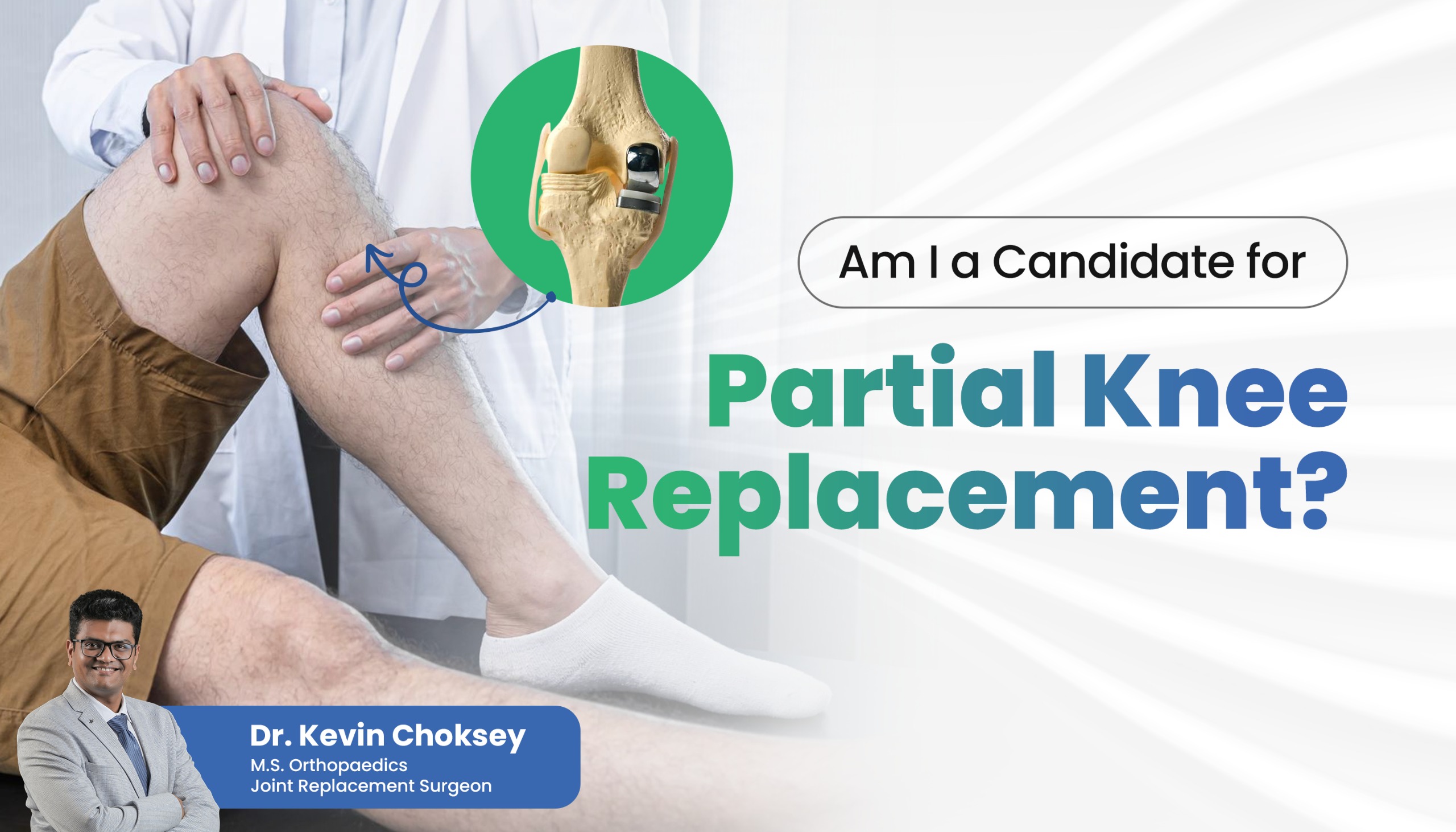
Knee pain has a way of creeping into every part of daily life — climbing stairs feels like a chore, a morning walk leaves you limping, and even sitting cross-legged for a family gathering seems impossible. If you have knee arthritis, you may have been told that you need a total knee replacement. But you may also be wondering:
“Does my entire knee really need to be replaced?”
For some patients, the answer is no.
For many patients, a smaller, more conservative surgery called A Partial knee replacement, also called a Unicompartmental knee replacement, or a Half knee replacement or a Microplasty can restore comfortable movement without removing the entire joint. In this particular procedure, the surgeon replaces only the damaged part of the knee and preserves the parts that are still healthy. It can be an excellent option when arthritis is truly limited to one compartment and the rest of the knee functions well.
What Is Partial Knee Replacement — and What Does “Microplasty” Mean?
The knee has three main compartments:
- Medial compartment — the inner side of the knee
- Lateral compartment — the outer side
- Patellofemoral compartment — the area behind the kneecap
In some people, arthritis becomes severe mainly in one compartment while the rest of the knee remains relatively preserved.
A partial knee replacement replaces that damaged compartment rather than resurfacing the entire knee.
The medical term is unicompartmental knee replacement (UKA) or partial knee replacement.
You may also hear the term Microplasty, particularly when discussing an Oxford partial knee replacement, which has been one of the oldest and most successful implants for a partial knee replacement.
Compared to a total knee replacement, Microplasty involves a smaller incision, less blood loss, less disruption to the surrounding muscles and ligaments, and a noticeably quicker return to daily activity for the right candidate.
But there is an important qualification:
Partial knee replacement is not better than total knee replacement for everyone.
The decision depends on much more than the severity of your pain. That is why the question is not simply, “How bad is my arthritis?”
It is:
“Is my arthritis suitable for a partial replacement, and will my knee function well with one?”
Who May Be a Candidate?
1. Arthritis Is Mainly Limited to One Compartment
This is probably the most important part of the assessment. For a medial partial knee replacement, for example, the arthritis should be concentrated in the medial compartment while the other parts of the knee remain suitable. A simple X-ray description such as “severe arthritis” is therefore not enough. The surgeon needs to understand where the arthritis is and whether the other compartments are still functioning well.
2. Your Knee Ligaments Are Functioning Well and the Knee is stable
The ligaments help control how the knee moves. For many medial Oxford partial knee replacements, particular attention is paid to the function of the anterior cruciate ligament (ACL) and the overall stability of the knee. This does not mean that every ligament finding can be reduced to a simple “yes” or “no” rule. What matters is whether the knee has the stability and function required for the planned replacement. That is one reason a physical examination is so important. If the knee is significantly unstable because of ligament problems or other structural damage, total knee replacement may be a more appropriate option.
3. You Have Useful Knee Movement
A very stiff knee may be less suitable for partial replacement. Your surgeon will assess how well you can straighten and bend the knee and whether there is a fixed limitation in movement. There is no single range-of-motion number that determines candidacy for every patient. The overall pattern of stiffness, deformity, ligament function and arthritis must be considered together.
4. Any Deformity Is Appropriate and Correctable
People often worry that having bow legs automatically rules them out.
It does not.
The important questions are:
- How severe is the deformity?
- Is it fixed or correctable?
- Which compartment is damaged?
- How does the knee balance during movement?
The type and correctability of deformity matter more than simply having a visible bow or knock-knee appearance.
5. X-rays showing isolated joint damage
An X-ray or MRI that shows cartilage wear in only one compartment — with the rest of the knee looking relatively healthy — is one of the strongest indicators for a partial procedure rather than a total knee replacement. There are also signs on a simple X-ray to show that the Ligaments are functionally intact.
6. Your Symptoms Are Affecting Your Life and Non-Surgical Treatment Is No Longer Enough
Pain alone does not determine whether you need surgery.
Your surgeon will want to know:
- Can you walk the distance you want?
- Are stairs becoming difficult?
- Has your walking speed changed?
- Can you exercise?
- Is sleep affected?
- Are everyday activities becoming harder?
- How much are you relying on pain medication?
The decision for surgery should consider both your symptoms and the structural condition of your knee. If physiotherapy, weight management, anti-inflammatory medication, and injections have failed to provide lasting relief, surgical intervention becomes a reasonable next step.
However, “failed physiotherapy” is not by itself an indication for partial knee replacement. The underlying knee condition still has to be suitable for the procedure.
These are general principles, not a self-diagnosis. A physical examination and appropriate imaging are needed before deciding between partial and total knee replacement. If several of these signs sound familiar, it’s worth getting a proper clinical evaluation rather than guessing based on symptoms alone.
Who May Not Be a Good Candidate?
Partial knee replacement may be unsuitable when:
- Arthritis affects multiple compartments significantly.
- The knee has substantial ligament instability.
- There is severe or fixed stiffness.
- The deformity is inappropriate or cannot be adequately corrected.
- There is an active infection.
- The pattern of inflammatory arthritis makes isolated compartment replacement unsuitable.
This does not mean that every person with one of these findings automatically needs a total knee replacement. This is exactly why an in-person evaluation with an experienced orthopaedic surgeon is essential before deciding on a treatment path — the “right” surgery depends entirely on the individual knee, not just the symptoms.
Does Age or Weight Rule You Out?
Age
There is no universal age at which you become “too old” or “too young” for partial knee replacement. Age is only one part of the decision. Research has found that younger age alone should not be considered a contraindication to unicompartmental knee replacement. The condition and function of the knee matter more.
Weight
Similarly, body weight should not be turned into a simple pass-or-fail rule.
Higher body weight can influence surgical risk, implant loading and long-term outcomes, particularly at very high levels. But modern evidence has challenged some of the older blanket restrictions around BMI and UKA.
Your surgeon should consider your weight together with your knee anatomy, activity level, medical health and the specific implant being considered.
Partial vs Total Knee Replacement — What Is the Difference?
| Partial Knee Replacement | Total Knee Replacement | |
| What is replaced? | Only the damaged compartment | The damaged surfaces of the whole knee |
| Healthy structures | More of the natural knee can be preserved | More of the knee is resurfaced |
| Ligaments | Important native ligaments are preserved. | Ligament management depends on the TKR design |
| Bone removal | Very less bone is resurfaced | More bone is resurfaced |
| Early recovery | Often faster in suitable patients | Usually more extensive recovery |
| Knee movement | All movements, including sitting on the floor and cross leg sitting are allowed. | Totally artificial implants do come with some restrictions. |
| Best suited to | Carefully selected compartment-specific arthritis | More widespread or unsuitable compartmental disease |
The right question is not- “Am I eligible for a partial replacement?” But “Which operation is most appropriate for my knee?”
What Tests Are Needed Before Deciding?
Clinical Examination
Your surgeon will assess:
- Where you feel pain
- Knee movement
- Ligament stability
- Deformity
- Knee alignment
- Tenderness
- Overall function
This information helps connect your symptoms with what is seen on imaging.
Weight-Bearing X-rays
X-rays are an important part of the assessment.
Standing X-rays can show:
- Joint-space narrowing
- Bone changes
- Alignment
- Which compartment is most affected
- The extent of arthritis
For some patients, additional stress views may help assess whether a deformity is correctable and how the compartments behave under load.
Is an MRI Always Necessary?
No.
An MRI can provide useful information about cartilage, menisci, ligaments and other soft tissues, but it is not automatically required for every patient being considered for partial knee replacement.
For many patients, the diagnosis and surgical planning can be made using the history, examination and appropriate weight-bearing radiographs.
MRI may be useful when the diagnosis is uncertain or when additional information about the soft tissues could change the treatment decision.
Older research has also shown that MRI can identify ligament abnormalities that do not necessarily correspond to the functional condition of the ligament found at surgery.
In other words:
An MRI report should not decide your operation. Your surgeon should interpret the imaging together with your symptoms and examination.
Why Patient Selection Matters So Much
Partial knee replacement can work extremely well when the patient, knee and procedure are well matched.
But the same operation can perform poorly if it is used for the wrong arthritis pattern.
That is why surgeon experience matters.
This is one reason a good consultation should not begin with:
“Do you want a partial or total replacement?”
It should begin with:
“What is actually happening inside your knee?”
Could You Be a Candidate for Microplasty?
Use this as a discussion guide, not a diagnosis.
Ask yourself:
- Is my arthritis mainly limited to one compartment?
- Is most of my pain coming from that damaged area?
- Does my knee remain reasonably stable?
- Can I still bend and straighten the knee reasonably well?
- Is any bow-leg or knock-knee deformity correctable?
- Are the other compartments of the knee reasonably preserved?
- Have non-surgical treatments stopped giving me enough relief?
- Is knee pain limiting the activities that matter to me?
If several answers are “yes”, it may be reasonable to ask an orthopaedic surgeon whether partial knee replacement should be considered.
But remember:
This checklist cannot tell you whether you need surgery.It simply tells you whether a partial-knee evaluation may be worth discussing.
The Bottom Line
Living with knee pain that limits your mobility doesn’t always mean you need a total knee replacement. If you have been told that you need a total knee replacement, it is reasonable to ask whether your arthritis is actually limited enough for a partial replacement.
But partial knee replacement is not a smaller version of total knee replacement.
It is a different operation for a different pattern of knee disease.
For right patients, partial knee replacement can preserve more of the natural knee and may provide faster early recovery. For others, total knee replacement may be the better and more predictable option.
If you are considering best partial knee replacement in Surat or elsewhere in Gujarat, a detailed orthopaedic assessment by Dr Kevin Choksey can help determine whether your knee is suitable for a partial procedure or whether another treatment would serve you better.
This blog is for informational purposes only and is not a substitute for professional medical advice. Please consult Dr. Kevin Choksey or a qualified orthopaedic surgeon for a diagnosis specific to your condition.