
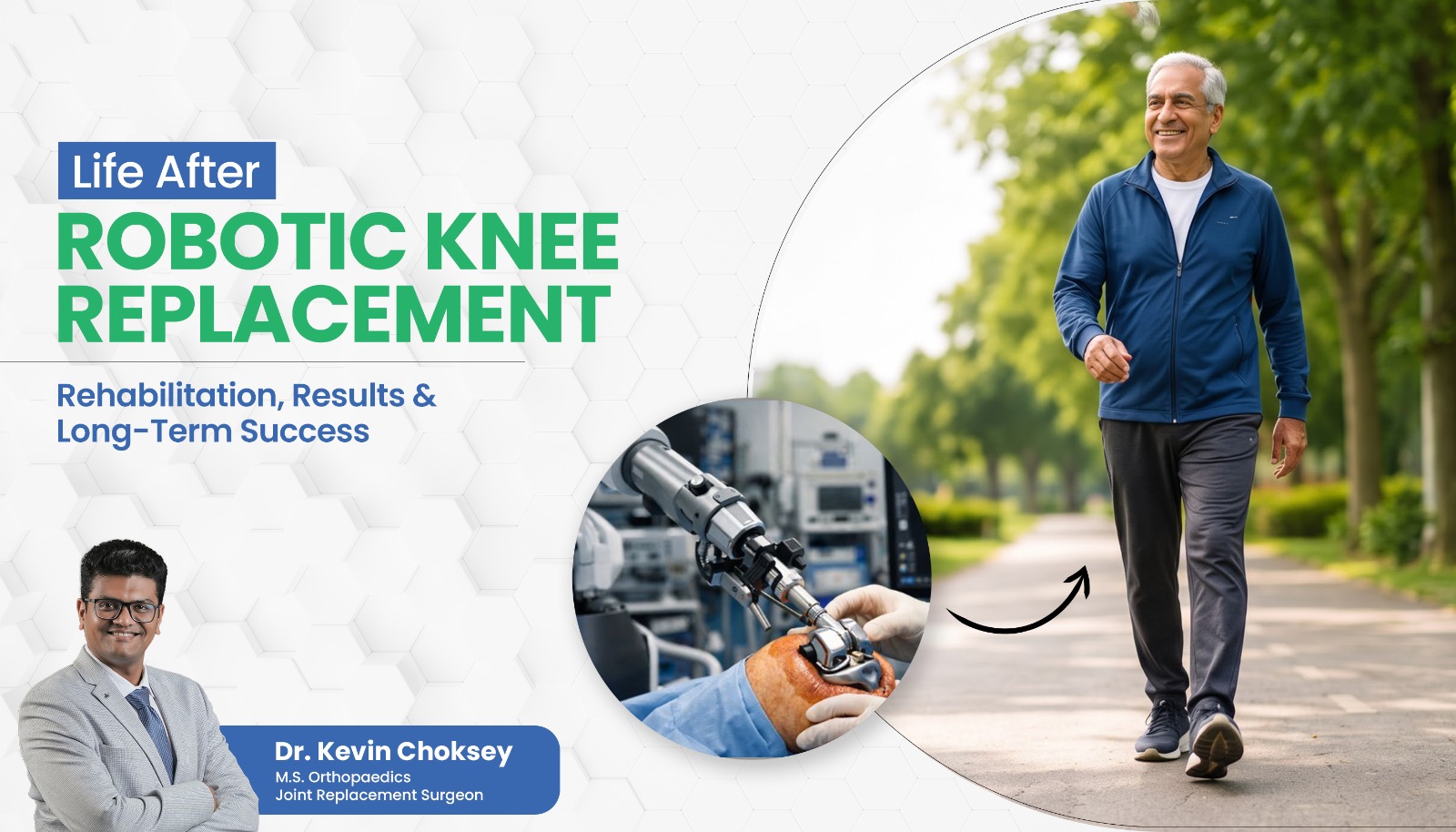
Knee pain has a way of shrinking your world. Stairs become a negotiation, walks get shorter, and activities you once loved slowly disappear from your calendar. If you’ve reached the point of considering surgery, you’ve probably already come across the term robotic knee replacement, and you’re likely wondering what life actually looks like on the other side of it.
This guide walks you through what to expect after robotic knee replacement surgery: the rehabilitation timeline, the results patients typically see, and what long-term success really depends on.
What Makes Robotic Knee Replacement Different
Traditional knee replacement relies on the surgeon’s hands, eyes, and instinct alone. Robotic knee replacement surgery adds a layer of precision; moreover, a 3D map of your knee is created before the procedure, and a robotic arm helps the surgeon position the implant exactly where it was planned, down to fractions of a millimeter.
It’s important to clear up a common misunderstanding here: the robot does not operate on its own. The surgeon remains in complete control throughout, using the robotic arm as a guided instrument rather than letting it make independent decisions. What the technology adds is consistency; every cut and every alignment measurement is checked in real time, which reduces the room for human error.
This precision shows up in the numbers. Robotic-assisted procedures are associated with smaller incisions, better preservation of healthy bone and surrounding ligaments, and noticeably less blood loss compared to conventional surgery. For patients, that translates into less trauma to the joint and a smoother start to recovery.
Types of Robotic Knee Replacement
Not every knee needs the same solution, and this is where understanding the different types of robotic knee replacement becomes useful:
Robotic Total Knee Replacement
– used when the entire joint surface is damaged, typically due to advanced arthritis. All three compartments of the knee are resurfaced.
Robotic Partial Knee Replacement (Microplasty/Unicompartmental)
– reserved for patients whose damage is limited to one part of the knee — medial, lateral, or the kneecap area. Only the affected portion is treated, while the healthy bone and ligaments elsewhere in the joint are left untouched.
Choosing between these isn’t something you do on your own — it depends on X-rays, the extent of joint damage, your activity level, and your surgeon’s clinical judgment during consultation.
The First 24–48 Hours After Surgery
Recovery begins almost immediately. Thanks to the Fast Track approach by Dr Kevin Choksey, most robotic knee replacement patients are encouraged to stand and take a few assisted steps within the first few hours of surgery, usually to the toilet seat first. This fast track approach to mobilisation isn’t about rushing — it’s a well-studied strategy that actually reduces complications like blood clots and stiffness while speeding up functional recovery. It also gives an immense sense of confidence to the patients – a reassurance that they are back on their own feet.
Pain in the first couple of days is managed through a combination of medication and nerve-block techniques, and physiotherapy typically starts at the bedside before you even leave the hospital.
9 out of 10 patients leave the hospital, walking without support and independently going up and down the stairs.
Weeks 1-4: Building the Foundation
This is the phase where most of the visible progress happens.
- Week 1: Focus is on reducing swelling, regaining basic range of motion, walking short distances and regaining muscle strength.
- Week 2: Bending the knee past 90 degrees becomes a realistic goal. Most patients get out of their homes by this time. Many patients return to desk-based work around this point, depending on their profession and how the knee is progressing.
- Week 3-4: Daily activities — dressing, using stairs, getting in and out of a car — start to feel manageable again. Consistency with physiotherapy matters more than intensity here. Skipping sessions or overdoing exercises out of impatience both tend to slow things down rather than speed them up.
Weeks 4-6: Regaining Strength and Confidence
By the 3 week mark, the knee is usually stable enough to focus on strength rather than just mobility. Quadriceps and hamstring strengthening, balance training, and low-impact activities like stationary cycling or swimming are gradually introduced.
Patients are usually more than 90% ok by the end of 6 weeks. However, occasional episodes of stiffness and pain can come in this time frame.
Weeks 6-12:
At approximately three months, most patients report their operated knee feels like a genuine part of their body again, rather than something they’re constantly monitoring. Walking without a limp, climbing a full flight of stairs comfortably, and standing for extended periods usually become achievable well within this window.
Long-Term Results: What to Realistically Expect
Long-term success after robotic knee replacement surgery depends on three things: how well the implant was aligned during surgery, how faithfully rehabilitation was followed, and how the joint is cared for afterward.
When these align, patients commonly experience:
- Significant, often complete, relief from the arthritic pain that led to surgery
- A more natural range of motion, since robotic techniques help preserve important ligaments like the PCL that guide the knee’s natural movement pattern
- Better implant longevity, as precise alignment reduces uneven wear on the artificial joint over time
- Return to activities like walking, cycling, dancing, and light sports — many patients specifically mention getting back to gardening, travel, or grandchildren-chasing as their personal milestone
Implants aren’t meant to last forever, but well-aligned Robotic knee replacements tend to hold up longer than those placed with less precision, simply because the forces through the joint are more evenly distributed.
Caring for Your Knee for the Years Ahead
A few habits go a long way in protecting your investment in a pain-free knee:
- Stay active, but choose low-impact exercise — walking, swimming, and cycling are kinder to the implant than running or jumping sports.
- Maintain a healthy weight — every extra kilogram adds measurable stress to the knee joint.
- Keep up periodic reviews with your surgeon, even once you feel completely normal, to catch any issues early.
- Don’t ignore new discomfort — occasional stiffness in cold weather is common, but persistent pain or swelling should always be checked.
Robotic Knee Replacement in India: A Growing, Trusted Option
Robotic knee replacement in India has matured significantly over the last several years. What was once available only in a handful of metro hospitals is now offered across major cities, backed by surgeons trained on the latest robotic platforms and supported by structured, fast-track rehabilitation protocols. For patients, this means world-class precision without the need to travel, along with the comfort of continuity of care close to home.
Within Gujarat, robotic knee replacement in Surat has become a well-established option, with dedicated joint replacement clinics offering the same robotic technology used in larger metros — making advanced, precise knee surgery accessible without long-distance travel for surgery or follow-up visits.
Why Choose Dr. Kevin Choksey for Robotic Knee Replacement Surgery?
If you’re searching for best robotic knee replacement doctors near me or top robotic knee replacement surgeons near me in Surat, here’s what sets Dr. Kevin Choksey’s practice apart:
- What sets his approach apart:
A good surgeon doesn’t just perform the surgery well. He uses all his efforts to minimize pain of the patient, and enable the patient a faster recovery. He will guide you through preparation, the procedure itself, and the months of recovery that follow. Dr Kevin Choksey has developed 4 unique practices which enable the patient a faster recovery, which he collectively calls Fast Track Knee Replacement. The elements of a fast track knee replacement are
1. Subvastus Approach — In conventional methods, during the surgery, the main muscle of the thigh- the quadriceps muscle is cut for approaching the joint. This leads to delayed muscle recovery as well as enhanced postoperative pain and stiffness. Instead, while using the Subvastus approach to enter the knee joint, this quadriceps muscle is not cut; it is retracted to one side and repositioned in its original place as soon as the surgery is over. As a result, the muscle recovers faster and allows patient early mobilisation. Most patients are able to walk without support the very next day.
2. Robotic Technology — Gives precise alignment, lesser soft tissue damage, perfect implant positioning.
3. Cruciate Ligament Retention — The strongest ligament of the knee, ie. PCL (Posterior Cruciate ligament) can be usually preserved. Since it is a natural structure, it provides excellent stability to the knee, 30-40% lesser bone resection from the thigh bone/femur, and faster stair climbing abilities.
4. Advanced pain management strategies — Pain management starts even before the surgery. Advanced nerve blocks, light painkillers, and structured rehabilitation support help the patient regain their mobility safely, comfortably and confidently.
If persistent knee pain has been affecting your daily life, a consultation is the best first step toward understanding whether partial/total knee replacement is right for you, to help you get back on track faster and stronger.
Conclusion
Life after robotic knee replacement isn’t just about getting rid of pain — it’s about getting your life back on your own terms, whether that means walking your dog without wincing, playing with your grandkids on the floor, or simply climbing your own staircase without holding the railing for support. With the right surgical precision and a committed approach to rehabilitation, that outcome isn’t the exception; for most patients, it’s the expectation.
If you’re exploring your options for robotic knee replacement in South Gujarat, a consultation is the best next step to understand which approach — total, partial, or fast-track — fits your knee and your lifestyle.
This article is for general informational purposes and does not replace personalised medical advice. Please consult Dr. Kevin Choksey directly for an evaluation specific to your condition.